A thermal camera for iPhone can reveal heat patterns that a standard camera cannot, helping with electrical checks, HVAC troubleshooting, insulation inspections, automotive work, and outdoor projects.
These 10 models cover current USB-C iPhones, older Lightning devices, Android phones, and a range of resolutions and lens designs. Use the guide below to match image quality, compatibility, and features to your work.
Best 10 Thermal Camera for Iphone Picks for 2026
Best Overall

- Dual-lens imaging with TISR-enhanced 512×384 output
- USB-C and Lightning adapters included
- -20°C to 550°C range with 25Hz imaging
Best For: Detailed phone-based inspections across multiple device types
Best for App-Based Analysis

- 320×240 QuadIR output with 25Hz refresh
- Visible-thermal fusion pinpoints specific components
- App includes graphs, isotherms, and multiple analysis tools
Best For: Detailed thermal analysis on iOS, Android, or Windows
Best USB-C Option

- Works with USB-C iOS, Android, and Windows devices
- 512×384 TISR-enhanced thermal output
- Measures from -4°F to 1022°F and up to 16.4 feet away
Best For: Portable inspections with newer USB-C phones and tablets
Best All-Around Pick

- Works with USB-C phones, older iPhones, and Windows computers
- Manual-focus macro lens plus 15× digital zoom
- Wide temperature range with alarms and reporting
Best For: Versatile home, HVAC, electrical, and automotive inspections
Best for Professional-Style Guidance
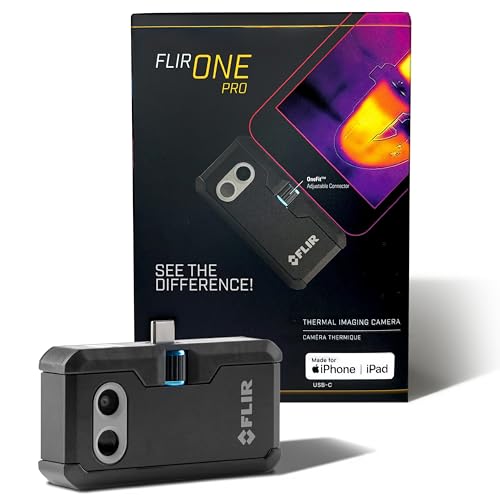
- Designed for USB-C iPhones, including iPhone 15 and newer
- MSX overlays visual details on thermal imagery
- App includes step-by-step inspection guides
Best For: Guided home inspections and rugged jobsite use
Best for Analysis Tools

- Enhanced 384 × 384 thermal images from a 96 × 96 sensor
- Works with compatible iOS, Android, and Windows devices
- Includes alarms, reports, guides, and AI-assisted insights
Best For: DIY inspections requiring analysis and documentation
Best with Extra Features

- 320×240 resolution with 25Hz refresh
- -4°F to 1112°F measurement range
- Compact design with 5–8 hours claimed operation
Best For: Home, HVAC, electrical, and automotive inspections
Best for Guided Inspections

- Designed for USB-C iPhone 15 and newer
- 240×180 enhanced imagery with FLIR MSX
- App includes step-by-step inspection guides
Best For: Guided home inspections and jobsite use
Best for High-Detail Imaging

- Up to 384×384 enhanced thermal imaging
- 25Hz refresh and 40mK sensitivity
- Includes alarms and PC report tools
Best For: Detailed professional and DIY inspections
Best Overall – TOPDON TC001 Max
The TOPDON TC001 Max is a versatile thermal camera for iPhone, iPad, and Android devices, particularly useful when you want high-detail imaging without carrying a separate handheld unit. Its dual-lens design, 25Hz refresh rate, broad temperature range, and USB-C/Lightning adapters suit both home troubleshooting and professional inspections.
Best For: HVAC, electrical, automotive, PCB, leak-detection, and wildlife inspections where detailed thermal imagery and broad device compatibility matter.
Pros:
- Dual-lens thermal and visible-light imaging helps clarify heat-related issues.
- TISR enhances 256×192 infrared data to 512×384, with 25Hz imaging and ≤40mK NETD sensitivity.
- Includes USB-C and Lightning adapters and works without batteries, charging, or wireless pairing.
- Compact 33g design and case-friendly construction make it easy to carry.
Cons:
- Some advanced features require the TopInfrared or TopView apps.
- Although broadly compatible, phone and tablet port requirements still need to be checked.
Choose the TC001 Max if you want one of the most flexible phone-connected options in this group. Its resolution enhancement, measurement range from -20°C to 550°C, and analysis tools give it a strong balance of portability and inspection capability.
Best for App-Based Analysis – RISION Magic Thermal Camera
The RISION Magic is a practical thermal camera for iPhone, Android, and Windows users who want measurement overlays and image analysis through a dedicated app. Its visible-thermal fusion, hot/cold spot tracking, and adjustable emissivity can help make inspection findings easier to interpret.
Best For: HVAC diagnostics, electrical panels, automotive repairs, home energy audits, and users who want detailed app-based reporting without registration.
Pros:
- Works with iOS, Android, and Windows devices through USB-C; Mac devices are not supported.
- Real-time visible and thermal image fusion helps pinpoint issues on individual wires, screws, or terminals.
- Offers 320×240 QuadIR output, 25Hz refresh, 40mK sensitivity, and a 52°×39° field of view.
- RISION View provides spot, line, area, threshold, PIP, graph, isotherm, photo, and video tools.
Cons:
- Native infrared resolution is 160×120, with the image upscaled to 320×240 QuadIR.
- Mac devices are not supported.
The RISION Magic stands out for hands-on analysis rather than simple heat-spot viewing. Its app controls and adjustable emissivity are useful for varied materials and inspection workflows, while the wide -20°C to 600°C measurement range supports demanding jobs.
Best USB-C Option – TOPDON TC002C Duo
The TOPDON TC002C Duo is a compact thermal camera for iPhone, iPad, Android, and Windows devices with USB-C ports. It combines TISR-enhanced imaging, temperature tracking, and photo and video capture in a lightweight design that is convenient for household troubleshooting or professional service calls.
Best For: USB-C phone and tablet users checking HVAC systems, electrical equipment, vehicles, household problems, or temperature changes from up to 16.4 feet away.
Pros:
- Compatible with USB-C iOS, Android, and Windows smartphones and tablets.
- Enhances 256×192 thermal imaging to 512×384 through TOPDON Image Super Resolution.
- Provides 25Hz tracking, 40mK sensitivity, and a -4°F to 1022°F measurement range.
- Small 30g body is easy to carry and supports photo and video recording through the TopInfrared app.
Cons:
- Not compatible with Mac devices or Android 16 devices temporarily, according to the supplied notes.
- USB-C-only compatibility excludes phones and tablets using Lightning ports.
This is a strong pick for newer USB-C devices when portability is a priority. Its enhanced resolution and 5-meter measurement distance make it useful for both close inspections and checking components that are difficult or unsafe to reach.
Best for Lightning iPhones – FLIR One
The FLIR One is a straightforward thermal camera for iPhone models with Lightning ports, including iPhone 14 and older devices. It plugs directly into the phone and combines Vivid IR super resolution with FLIR MSX visual detailing, making it a convenient choice for home inspection and general maintenance tasks.
Best For: Lightning-equipped iPhone users who want guided inspections for air leaks, moisture buildup, automotive issues, and other household or commercial problems.
Pros:
- Connects directly to iPhones with Lightning ports, including iPhone 14 and older models.
- Upscales 80×60 native infrared imagery to 240×180 and adds FLIR MSX visual detail.
- FLIR One app includes step-by-step inspection guidance for common faults.
- Jobsite-tough construction is rated for a 1.5-meter drop.
Cons:
- Compatibility is limited to Lightning-port iPhones; newer USB-C iPhones are not covered by the supplied notes.
- Temperature accuracy is specified for particular ambient and scene temperature ranges.
- Its native infrared resolution is lower than the newer 256×192 models in this roundup.
The FLIR One remains a sensible choice for an older Lightning iPhone, especially if guided workflows are more important than maximum resolution. Its MSX overlay and rugged housing make everyday troubleshooting more approachable.
Best All-Around Pick – Thermal Master P3
The Thermal Master P3 is a versatile thermal camera for iPhone and Android users who want broad compatibility, detailed imaging, and a manual-focus lens. It connects directly to compatible phones, includes an adapter for older iPhones, and works with Windows computers.
Best For: Homeowners, DIY users, HVAC checks, electrical troubleshooting, automotive diagnostics, and close-up circuit-board inspections.
Pros:
- Supports USB-C phones, older iPhones with the included Lightning adapter, and Windows computers.
- Manual focus enables 8mm macro inspection and mid-range viewing with a 40° × 30° field of view.
- Wide -4°F to 1,112°F measurement range, hot/cold spot tracking, and up to 15× digital zoom.
- Battery-free design, app-based reports, alarms, recording, IP54 protection, and 1m drop-tested durability.
Cons:
- Native resolution is 256 × 192, with enhanced output produced through the imaging algorithms.
- Manual focusing may require more hands-on adjustment than a fixed-focus camera.
The P3 stands out for combining macro capability, a broad temperature range, and practical inspection features in a compact phone-powered design. It is a strong choice when you want one thermal camera for varied household, workshop, and field tasks.
Best for Professional-Style Guidance – FLIR ONE Pro
The FLIR ONE Pro is a practical thermal camera for iPhone users with USB-C models, including iPhone 15 and newer. Its FLIR MSX processing overlays thermal information with visual details, while the companion app provides guided inspection steps.
Best For: iPhone 15-and-newer owners, home inspections, jobsite use, and users who want guided help identifying air leaks, moisture, and other common issues.
Pros:
- FLIR Vivid IR upscales 160 × 120 native infrared data to 480 × 360 resolution.
- MSX technology combines thermal and visual imagery to make features easier to interpret.
- App-based inspection guides support common home-inspection tasks.
- 1.5m drop rating suits demanding jobsite environments.
Cons:
- Compatibility is specified for USB-C iPhones, including iPhone 15 and newer.
- Its stated accuracy is ±3°C or ±5% under specified temperature conditions.
The FLIR ONE Pro is a focused option for iPhone users who value recognizable image overlays and step-by-step inspection assistance. Its jobsite-oriented construction adds confidence for repeated professional or DIY use.
Best for Analysis Tools – TOPDON TC001 Mini
The TOPDON TC001 Mini is a compact thermal camera for iPhone, Android, iPad, and Windows devices. It combines enhanced 384 × 384 thermal output with measurement tools, inspection guides, and AI-assisted explanations for investigating temperature differences.
Best For: DIY inspectors, HVAC and electrical troubleshooting, vehicle checks, and users who want thermal reports and guided analysis.
Pros:
- 96 × 96 sensing with TISR processing produces 384 × 384 thermal images.
- Supports compatible iOS, Android, and Windows devices with mobile and PC software.
- Offers hot/cold spots, isotherms, measurement areas, limits, alarms, and report generation.
- AI-powered explanations and inspection guides can suggest possible causes and next steps.
Cons:
- Requires a compatible phone or computer because it has no built-in battery or standalone display.
- Device compatibility should be confirmed before purchase across iOS, Android, and Windows hardware.
The TC001 Mini is especially appealing when interpreting and documenting thermal findings matters as much as capturing them. Its PC software, reporting tools, and AI features give DIY users more ways to investigate unusual heat patterns.
Best with Extra Features – Thermal Master P1
The Thermal Master P1 is a versatile thermal camera for iPhone and other USB-C devices, offering 320×240 infrared resolution, a broad temperature range, and useful inspection controls. iPhones with a Lightning port require a separately sold USB-C-to-Lightning adapter.
Best For: Home insulation checks, HVAC diagnostics, electrical inspections, automotive troubleshooting, and users who want a compact camera with strong control features.
Pros:
- 320×240 resolution, 25Hz refresh rate, and detection of temperature differences as small as 0.04°C.
- Measures from -4°F to 1112°F with ±3.6°F accuracy.
- Includes 15× digital zoom, temperature alarms, isotherm mode, and adjustable measurement settings.
- Compact 0.62-ounce design with claimed 5–8 hours of continuous operation.
Cons:
- Lightning-port iPhones need a separate adapter.
- Some advanced settings may be more than casual users need.
With its high resolution, wide temperature range, and long claimed operating time, the P1 is a strong general-purpose choice. Confirm your iPhone connector before buying and plan for an adapter if necessary.
Best for Guided Inspections – FLIR One for iPhone
The FLIR One is a purpose-built thermal camera for iPhone models with USB-C, including the iPhone 15 and newer. Its FLIR MSX image enhancement and in-app inspection guides make it a practical option for users who want visual context and step-by-step help.
Best For: iPhone 15-and-newer owners, home inspections, and jobsite users who value guided workflows and a rugged enclosure.
Pros:
- Plugs directly into USB-C iPhones and is designed for iPhone 15 and newer.
- Upscales 80×60 native infrared imagery to 240×180 using Vivid IR technology.
- FLIR MSX combines thermal and visual details to make images easier to interpret.
- Includes in-app guides for identifying air leaks, moisture buildup, and other common issues.
Cons:
- Compatibility is limited to USB-C iPhones listed by the product notes.
- Native infrared resolution is 80×60, with the higher resolution produced through upscaling.
- Temperature accuracy depends on the stated environmental and scene ranges.
The FLIR One stands out for its guided app experience, MSX overlays, and 1.5-meter drop rating. It is best suited to compatible USB-C iPhone users who want an approachable inspection tool rather than the broadest temperature range.
Best for High-Detail Imaging – AMPBANK M192 Thermal Camera
The AMPBANK M192 is a high-detail thermal camera for iPhone and other USB-C devices, using processing to enhance 192×192 imagery to as much as 384×384. It also adds temperature alarms, multiple color modes, and PC analysis software for users who need more than basic heat-spot viewing.
Best For: Electrical, HVAC, leak, automotive, PCB, and industrial inspections where sharper thermal patterns and report-generation tools are useful.
Pros:
- Offers selectable 240×240 and 384×384 TISR modes depending on the device.
- 25Hz refresh rate and 40mK sensitivity support smooth real-time heat tracking.
- Includes high- and low-temperature alarms plus adjustable emissivity, ambient temperature, and distance settings.
- Provides 10 color palettes, PC analysis software, thermal report generation, and Excel data export.
Cons:
- Requires a USB-C device and the ThermCam app; Mac compatibility is currently unavailable.
- The highest 384×384 mode is intended for flagship devices.
- Its broader feature set may be excessive for simple occasional checks.
The M192 is the feature-heavy choice in this group, combining enhanced resolution with alarms and analysis software. If your iPhone uses USB-C and you expect to document or compare inspection results, its workflow is particularly compelling.
How We Picked the Best Thermal Camera for Iphone Options
We focused on models designed for smartphone use and compared the specifications that matter most in real projects: connector compatibility, infrared resolution, temperature measurement, image features, lens flexibility, and ease of use. The selection includes Lightning and USB-C options, as well as cameras that also work with iPads or Android devices.
Higher resolution can make small temperature differences and narrow targets easier to interpret, but it is not the only consideration. A compatible connector, dependable app, useful temperature tools, and an appropriate field of view may matter more for occasional home inspections or quick troubleshooting.
Quick Comparison
| Best For | Look For |
|---|---|
| General home inspection | Balanced resolution, easy app controls, and broad compatibility |
| Electrical and HVAC work | Reliable temperature readings, spot tracking, and clear thermal detail |
| Small components or close-up repairs | Macro or manual-focus lens support |
| Older iPhones | Lightning compatibility, such as compatible FLIR One models |
| Newer iPhones and mixed devices | USB-C connectivity and cross-platform support |
Key Buying Factors for a Thermal Camera for Iphone
Connector and Device Compatibility
Check your iPhone model before buying. iPhone 15 and newer models generally use USB-C, while many earlier iPhones use Lightning. A camera may require a particular connector orientation, app, or operating-system version. If you plan to use it with multiple devices, choose a model that explicitly supports your iPhone, iPad, or Android phone.
Infrared Resolution and Image Clarity
Resolution affects how much detail appears in the thermal image. Models around 160×120 or 240×180 can be suitable for household diagnostics, while 320×240 and 384×384 cameras provide more detail for larger areas, distant targets, and professional-style inspections. Super-resolution claims should not be confused with the sensor’s native infrared resolution.
Temperature Tools and Measurement Range
Look for adjustable emissivity, center and spot measurements, hot- and cold-spot tracking, and a temperature range suited to your work. These features help turn a colorful image into useful diagnostic information. Reflective metal, glass, moisture, distance, and surface finish can affect accuracy, so thermal readings should be treated as guidance rather than absolute measurements.
Lens Design and Field of View
A wide view is helpful for walls, panels, and HVAC equipment. A manual-focus or macro lens is better when inspecting circuit boards, connectors, solder joints, or other small objects at close range. Consider whether you need to frame a large area or isolate a tiny heat source.
Software and Handling
The companion app should make it easy to view, capture, annotate, and share images. Also consider the camera’s size, connector clearance, phone-case compatibility, power requirements, and whether it can operate while the phone is held in a protective case.
Who Should Buy Which Thermal Camera for Iphone?
Choose a High-Resolution Model for Detailed Inspections
For contractors, inspectors, and serious DIY users, a 320×240 or 384×384 option can provide a clearer view of heat patterns across electrical systems, building envelopes, machinery, and vehicles.
Choose a Compact Entry-Level Model for Occasional Use
If you mainly want to find drafts, overheated outlets, blocked vents, or uneven heating, a lower-resolution camera with dependable app controls may offer the best value and simpler operation.
Choose a Macro-Capable Camera for Electronics
Repair technicians and electronics hobbyists should prioritize a manual macro lens or close-focus design. It can make small components easier to separate thermally than a general-purpose wide-angle camera.
Choose by Connector First When Compatibility Is Critical
For older Lightning iPhones, select a Lightning-compatible model rather than relying on adapters. For USB-C iPhones, confirm the camera and app support your exact device before purchase, especially if you use a case or want to switch between Apple and Android hardware.