The best Bluetooth battery monitors make it easier to check voltage, charging behavior, cranking performance, and battery health from your phone. They can help identify weak batteries before they leave you stranded and simplify routine maintenance.
This roundup compares 10 Bluetooth-enabled options, from compact automotive testers to higher-current smart shunts for RV, marine, solar, and off-grid systems. Focus on system voltage, battery chemistry, current capacity, and the measurements you actually need.
Best 10 Bluetooth Battery Monitors Picks for 2026
Advanced Shunt Monitoring
Victron Energy SmartShunt 300A

- Detailed state-of-charge and battery history data
- VE.Smart, VRM, and DVCC integration support
- Auxiliary connection for expanded monitoring
Best For: Victron-based battery systems needing comprehensive data
Vehicle Battery Tracking
Antigravity Battery Tracker Plus

- Supports 6V, 12V, and 24V battery systems
- Stores 72 days of history with data export
- Provides alerts and multi-vehicle app monitoring
Best For: Vehicle owners who want preventive battery alerts
12V Battery Testing

- Designed for 12V lead-acid batteries
- Checks voltage, cranking, charging, and starting
- Includes low-voltage alerts and iOS/Android app support
Best For: Everyday 12V vehicle and solar-system checks
Water-Resistant System Monitoring

- IP65 water- and dust-resistant enclosure
- Detailed battery data through VictronConnect
- Supports Victron networking and system controls
Best For: Dust- or moisture-exposed Victron battery systems
Versatile 12V Pick
BM2/BM3 Bluetooth Battery Tester
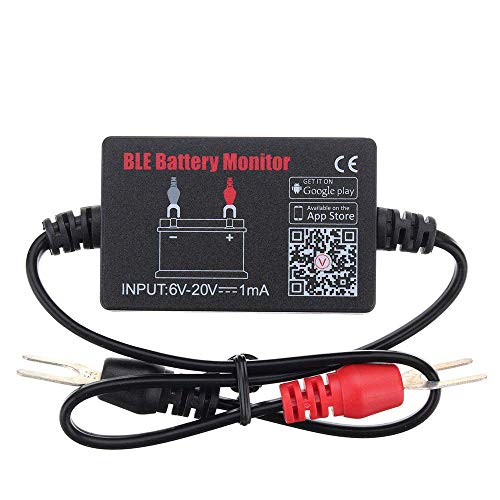
- Tests 12V batteries across a 6–20V range
- Reports charge, cranking, and starting data
- BM3 app supports up to four monitors
Best For: 12V automotive battery checks from Android or iOS
Smart Shunt Choice
LiTime 500A Bluetooth Battery Monitor

- Covers 8–120V battery systems
- Tracks live power and state of charge
- Includes alerts and historical data
Best For: RV, marine, and home backup battery banks
Long-Term Installation Pick
ANCEL BM300 Pro Bluetooth Battery Monitor
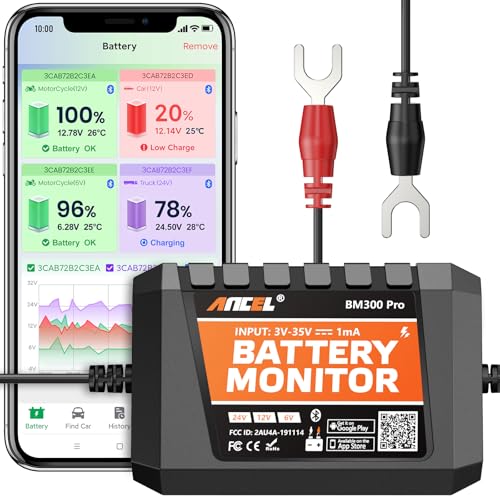
- Monitors 6V, 12V, and 24V systems
- Stores up to 72 days of disconnected history
- IP67 housing supports permanent installation
Best For: Long-term vehicle and multi-battery monitoring
Best All-in-One Monitor
FOXWELL BT630 600A Smart Shunt

- Tracks voltage, current, power, capacity, and state of charge
- Supports 10V–120V systems and up to 600A
- Includes alerts, 30-day history, and RS-485 integration
Best For: RV, marine, solar, backup, and off-grid power systems
Best for 12V Vehicles
ANCEL BM200 Bluetooth Battery Tester

- Performs voltage, cranking, and charging-system tests
- Stores up to 70 days of readings
- Monitors up to four devices through the app
Best For: Cars, motorcycles, trucks, RVs, and boats with 12V batteries
Best Multi-Voltage Option

- Monitors 6V, 12V, 24V, and 48V systems
- Supports up to six monitors in one app
- Includes waveform, temperature, cranking, and charging tests
Best For: Multi-vehicle households, garages, RVs, boats, and mixed-voltage systems
Advanced Shunt Monitoring – Victron Energy SmartShunt 300A
For buyers comparing bluetooth battery monitors, the Victron Energy SmartShunt 300A is designed for detailed battery tracking through the VictronConnect smartphone app. Its shunt-based measurements cover both everyday status checks and longer-term battery data.
Best For: System builders who want detailed battery metrics and Victron device integration.
Pros:
- Displays state of charge, time remaining, voltage, current, amp hours, and charge-cycle data.
- Supports VE.Smart Networking, VRM, and DVCC integrations with compatible Victron systems.
- Auxiliary connection can support a second monitor, midpoint monitoring, or an optional temperature sensor.
Cons:
- Its advanced shunt and integration features may be more than needed for basic voltage checks.
- Requires installation into the battery system rather than a simple plug-in connection.
The SmartShunt 300A is a strong choice when accurate, system-level battery information matters more than a minimal installation.
Vehicle Battery Tracking – Antigravity Battery Tracker Plus
Among bluetooth battery monitors, the Antigravity Batteries Bluetooth Battery Tracker Plus focuses on vehicle owners who want phone-based voltage alerts and battery-performance history. It supports several battery voltages and provides app tools for monitoring multiple vehicles.
Best For: Cars, motorcycles, RVs, boats, and powersports vehicles needing remote battery alerts.
Pros:
- Works with 6V, 12V, and 24V lithium, AGM, and lead-acid batteries.
- Logs up to 72 days of voltage history and allows data export as a spreadsheet.
- Monitors voltage, cranking performance, and charging-system data with customizable alerts.
- Can track up to four vehicles and displays the last parked location in the app.
Cons:
- Its phone-based features depend on Bluetooth connection range and app compatibility.
- The supplied details focus on vehicle monitoring rather than full shunt-based energy accounting.
This tracker is a practical fit for preventing unexpected dead batteries and reviewing vehicle charging behavior over time.
12V Battery Testing – BM2 Bluetooth Battery Monitor
The BM2 is a straightforward option among bluetooth battery monitors for 12V lead-acid vehicle and backup systems. Its app reports voltage, charging behavior, cranking power, and starting-system information when the monitor is within Bluetooth range.
Best For: Owners of 12V lead-acid batteries in cars, trucks, motorcycles, boats, RVs, and solar systems.
Pros:
- Supports 12V batteries across vehicles, boats, RVs, and solar power systems.
- Performs voltage, charging, cranking, and engine-starting checks through the app.
- Provides an automatic low-voltage alarm when the device enters Bluetooth range.
- Free iOS and Android app records driving and battery-condition information.
Cons:
- It is intended for 12V lead-acid batteries, so it is less flexible than multi-voltage monitors.
- Alerts require the user to be within the stated 10-meter Bluetooth range.
For basic 12V diagnostics and low-voltage warnings, the BM2 offers useful testing without the broader system integrations of a dedicated shunt monitor.
Water-Resistant System Monitoring – Victron SmartShunt IP65
Victron Energy SmartShunt IP65 Battery Monitor (Bluetooth) - Victron Smart Shunt - 6.5V-70V, 300 amp
Check Price On AmazonThe Victron SmartShunt IP65 combines bluetooth battery monitoring with a water- and dust-resistant design. It measures detailed battery performance through the VictronConnect app while sharing live data with compatible Victron equipment for coordinated system control.
Best For: Battery systems exposed to moisture or dust that need Victron integration and detailed readings.
Pros:
- IP65 water- and dust-resistant construction supports a wider range of installation environments.
- Measures state of charge, time remaining, voltage, current, amp hours, and charge-cycle information.
- Supports VE.Smart Networking, VRM, and DVCC with compatible Victron systems.
- Integrated auxiliary connection supports midpoint monitoring, a second monitor, or an optional temperature sensor.
Cons:
- Its shunt-based installation is more involved than a simple plug-in voltage tester.
- Advanced Victron networking features may be unnecessary for basic battery monitoring.
The IP65 version is especially compelling when environmental resistance is important alongside precise readings and Victron ecosystem compatibility.
Versatile 12V Pick – BM2/BM3 Bluetooth Battery Tester
This compact Bluetooth battery monitor is designed for 12V automotive batteries, letting you check voltage, charge, cranking power, and engine-starting status from an Android or iOS device. The BM2 app supports one battery, while the BM3 app can monitor up to four compatible devices.
Best For: Drivers who want app-based monitoring for one or several 12V vehicle batteries.
Pros:
- Works with 12V batteries and has a 6–20V test range.
- Provides voltage, charge, cranking, and starting information.
- Sends battery-status notifications when the phone enters Bluetooth range.
- Supports Android and iOS devices.
Cons:
- Monitoring up to four batteries requires the BM3 app, which is not free.
- Bluetooth notifications depend on being within range.
Choose this model if your priority is straightforward 12V automotive testing in a small, affordable package. It is less suited to higher-voltage battery banks or remote, out-of-range monitoring.
Smart Shunt Choice – LiTime 500A Bluetooth Battery Monitor
The LiTime 500A Bluetooth battery monitor uses a smart shunt and mobile app to track current, voltage, power, and state of charge. Its broad 8–120V compatibility makes it suitable for RV, marine, home backup, and other multi-voltage battery systems.
Best For: RV, marine, and backup-power users who need detailed battery-system data and historical tracking.
Pros:
- Supports 8–120V systems, including 12V, 24V, 36V, and 48V batteries.
- Tracks charge/discharge current, voltage, power, and state of charge.
- Offers adjustable alarms for capacity, temperature, voltage, and current conditions.
- Provides historical data such as cycles, discharge capacity, and voltage highs and lows.
Cons:
- Its shunt-based design is more involved than a simple plug-in voltage monitor.
- App monitoring requires pairing with a mobile device.
This is the strongest fit for users managing a complete battery bank rather than checking a single car battery. The wide voltage range and configurable alerts add useful planning and troubleshooting capabilities.
Long-Term Installation Pick – ANCEL BM300 Pro Bluetooth Battery Monitor
The ANCEL BM300 Pro is a versatile Bluetooth battery monitor for 6V, 12V, and 24V systems. Its app displays voltage, estimated state of charge, temperature, and stored history, while supported 12V and 24V vehicle systems also receive cranking and charging tests.
Best For: Users who want a permanently installed monitor for vehicles or multiple battery systems.
Pros:
- Supports 6V, 12V, and 24V batteries.
- Stores up to 72 days of history while disconnected and syncs after reconnection.
- IP67-rated housing and approximately 1mA average current draw suit long-term installation.
- One app can display up to four BM300 Pro monitors.
Cons:
- This package includes one monitor; additional batteries require additional units.
- It is Bluetooth-only, with no Wi-Fi, cellular, or unlimited-distance monitoring.
- Cranking and charging tests are not supported on 6V systems.
Choose the BM300 Pro when durable installation and historical data matter more than remote access. It offers broader system compatibility than a typical 12V automotive monitor, with clear limits on Bluetooth range and 6V testing.
Best All-in-One Monitor – FOXWELL BT630 600A Smart Shunt
The FOXWELL BT630 is a feature-rich choice among bluetooth battery monitors for RVs, boats, solar systems, and off-grid batteries. Its 600A smart shunt tracks voltage, current, power, state of charge, and estimated time remaining through the PRO BMS App.
Best For: RV, marine, solar, backup, and off-grid systems that need detailed battery and energy-use monitoring.
Pros:
- Monitors voltage, amperage, wattage, capacity, temperature, and true state of charge.
- Supports 10V–120V systems and up to 600A, with compatibility across lithium, LiFePO4, AGM, Gel, and flooded lead-acid batteries.
- Offers custom alarms, 30 days of historical data, a protective cover, and an RS-485 port.
Cons:
- Its broad feature set may be more than a basic automotive battery user needs.
- Installation requires connecting a smart shunt and configuring the battery system in the app.
The BT630 stands out when you want a complete battery-management view rather than a simple voltage reading. Its wide voltage range, high current capacity, alerts, and data history make it particularly practical for larger mobile or off-grid power systems.
Best for 12V Vehicles – ANCEL BM200 Bluetooth Battery Tester
The ANCEL BM200 is a practical pick among bluetooth battery monitors for drivers who want ongoing 12V battery and vehicle-system checks. The app displays live information, records trip data, and performs cranking and charging tests for compatible cars, motorcycles, trucks, RVs, and boats.
Best For: 12V vehicle owners who want battery alerts, starting checks, charging-system information, and multi-vehicle monitoring.
Pros:
- Tests battery voltage, cranking performance, and charging-system operation.
- Stores up to 70 days of data, recording battery information every two minutes.
- Supports monitoring up to four devices and includes IP67 protection, reverse-polarity protection, and short-circuit protection.
Cons:
- It is designed for 12V lead-acid and lithium batteries rather than broad-voltage systems.
- Some location features require GPS permission.
- Bluetooth monitoring is intended for a roughly 15–30-foot range.
Choose the BM200 if your priority is vehicle readiness rather than detailed RV energy accounting. Its cranking and charging tests add useful context beyond voltage alone, while alerts and historical records can help identify battery problems before they become roadside surprises.
Best Multi-Voltage Option – KONNWEI BK400 6V–48V Monitor
The KONNWEI BK400 is one of the more flexible bluetooth battery monitors for mixed vehicle and battery setups. It supports 6V, 12V, 24V, and 48V systems, while its app provides live voltage, waveform, temperature, history, and abnormal-voltage alerts.
Best For: Households, garages, and owners managing batteries across motorcycles, cars, trucks, RVs, boats, and other compatible systems.
Pros:
- Works with 6V–48V battery systems and multiple battery types, including AGM, EFB, VRLA, Gel, flooded, and lithium.
- Allows up to six BK400 monitors to be managed from one app.
- Bluetooth 5.2, low-power sleep mode, waveform viewing, and cranking and charging tests support long-term monitoring.
Cons:
- The listed upper operating specification is 60V, so it is not intended for systems above that range.
- Live monitoring and alerts depend on Bluetooth range and app connectivity.
The BK400 is a strong fit when one monitor needs to cover several battery voltages or multiple vehicles. Its six-device management and low-power installation are useful for ongoing checks, while the system tests provide more insight than a basic voltage monitor.
How We Picked These Bluetooth Battery Monitors
We selected models that cover the most common use cases, including 12V automotive batteries, 6V and 24V systems, multi-voltage battery banks, and higher-current RV or solar installations. We considered supported voltage ranges, maximum current, Bluetooth connectivity, app-based monitoring, testing functions, alarm features, installation requirements, and overall versatility.
Some products are designed primarily for quick vehicle checks, while others use a permanently installed shunt to measure current flowing into and out of a battery. That distinction matters: a voltage tester can provide a snapshot, but a shunt-based monitor is generally better for tracking state of charge over time.
Quick Comparison
- For permanent battery-bank monitoring: Choose a smart shunt such as the Victron Energy, LiTime, or FOXWELL options, provided its current and voltage ratings match your system.
- For vehicle diagnostics: BM2, ANCEL, Antigravity, and KONNWEI testers are aimed at checking battery voltage, cranking, charging, or general automotive condition.
- For mixed-voltage systems: Verify the exact supported range before buying. Some monitors are limited to 12V, while others support 6V, 24V, 48V, or substantially higher DC voltages.
- For simple phone alerts: Look for low-voltage notifications, charging or cranking tests, and an app with clear readings.
Key Buying Factors for Bluetooth Battery Monitors
Voltage and Battery Compatibility
Match the monitor to the battery system, not just the vehicle or device. Check whether it supports lead-acid, AGM, gel, lithium, or another chemistry, and confirm the minimum and maximum voltage. A monitor rated for 12V automotive use may not be suitable for a 24V truck or a 48V battery bank.
Current Rating and Shunt Size
For shunt-based monitors, choose a current rating higher than the maximum continuous and peak load your system can produce. A 300A shunt may suit many vehicles and moderate battery banks, while larger inverters and high-power systems may require 500A or 600A capacity. Also check terminal size and cable requirements before installation.
What the App Measures
Basic testers may show voltage and battery-test results. More advanced systems can track amperage, watts, accumulated charge, estimated capacity, historical trends, and alarms. Prioritize the measurements that support your maintenance routine rather than paying for features you will not use.
Installation, Range, and Alerts
Permanent monitors generally require wiring the shunt into the negative side of the battery system. Confirm that the Bluetooth range works for your intended setup and that the app supports the required phone platform. Low-voltage and other protection alarms are especially useful for unattended vehicles, boats, and solar installations.
Who Should Buy Which Bluetooth Battery Monitors?
Car owners who want occasional checks should choose a compact automotive tester with cranking and charging tests. RVs, boats, and solar users will usually benefit more from a permanently installed smart shunt that tracks current and state of charge. Owners of lithium or larger battery banks should prioritize chemistry support, a suitable voltage range, adequate current capacity, and configurable readings. If you only need a quick battery-health check, a simpler Bluetooth tester is likely the better-value choice.